
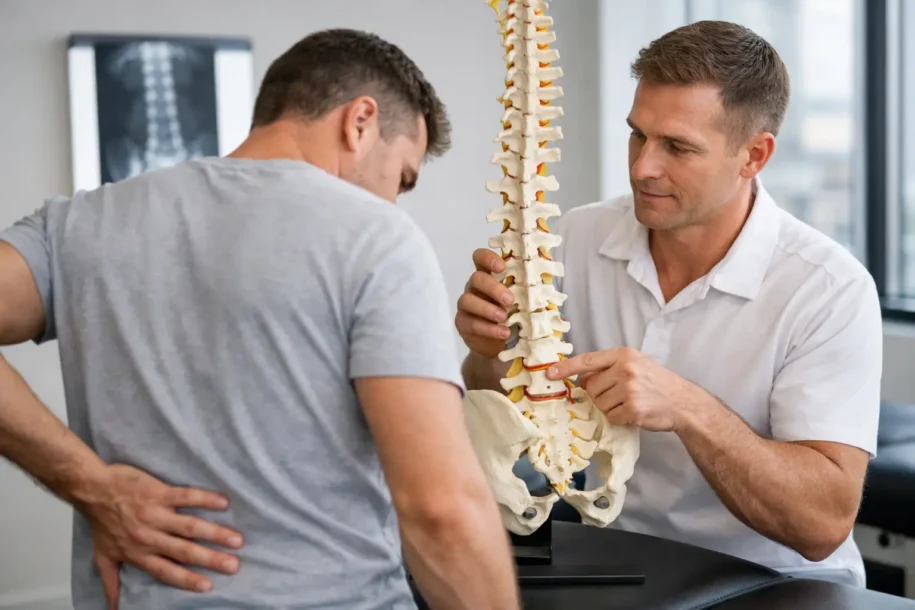
A sudden bend to lift a bag, a long drive, or simply getting out of bed can be enough to turn an irritated spinal disc into a problem that affects every part of the day. If back pain is travelling into your buttock, leg, shoulder or arm, a disc injury chiropractor can help determine whether your symptoms may be linked to disc irritation, nerve involvement or another cause requiring a different approach.
Disc pain is not always caused by a dramatic accident. It can build gradually when repeated sitting, poor movement control, deconditioning or previous injuries place more stress on the spine than it can comfortably manage. The key is not simply to chase pain relief. It is to understand what is happening, protect the area while it settles and build the movement capacity needed to return to normal life.
What is a disc injury?
The discs sit between the bones of the spine. They act as cushions and help the spine move, absorb load and remain stable. Each disc has a firmer outer layer and a softer inner material. With strain, age-related change or injury, a disc can become irritated, bulge or, in some cases, place pressure on nearby nerve tissue.
People often use terms such as slipped disc, bulging disc and herniated disc interchangeably. These terms describe different patterns of disc change, but the scan finding alone does not always explain a person’s pain. Some people have disc changes with no symptoms at all, while others experience marked pain, stiffness or leg pain without a severe-looking scan result.
A thorough assessment considers the whole clinical picture: how the pain began, where it travels, which movements aggravate it, how your strength and sensation are functioning, and how your spine is moving. This gives a more useful starting point than assuming every episode of back pain is a disc problem.
Signs that may point to disc-related pain
Disc irritation can present differently depending on the area of the spine involved. Lower back disc problems may cause local back pain, pain into the buttock or leg, pins and needles, altered sensation or weakness. When a nerve in the lower back is affected, this is commonly described as sciatica.
In the neck, disc-related symptoms may include neck pain, restricted turning, pain around the shoulder blade, headaches, or symptoms travelling into the shoulder, arm or hand. Coughing, sneezing, prolonged sitting, bending, lifting and twisting may make symptoms worse for some people, although there is no single pattern that applies to everyone.
Symptoms can also be influenced by poor sleep, stress, reduced activity and protective muscle tension. That is why an individual assessment matters. A treatment plan should reflect your symptoms, goals, job, daily demands and current capacity rather than follow a one-size-fits-all routine.
When urgent medical advice is needed
Most back and neck pain does not require emergency care, but certain symptoms should never be ignored. Seek urgent medical assessment if you develop new problems controlling your bladder or bowel, numbness around the groin or saddle area, rapidly worsening leg weakness, major loss of balance, fever with severe spinal pain, or pain following significant trauma.
A chiropractor should also refer you for further medical investigation where your history, examination findings or progression indicate that this is appropriate. Good care includes recognising when chiropractic management is not the right next step.
How a disc injury chiropractor assesses the problem
A useful first appointment is more than a quick look at where it hurts. At Reliable Spine, assessment is designed to identify the factors that may be contributing to your symptoms and limiting your recovery.
This begins with a detailed discussion about the onset of pain, previous episodes, work set-up, exercise, sleep, medication and any changes in strength or sensation. Your chiropractor will then assess posture, spinal movement, joint function, muscle control and relevant neurological signs. Depending on your presentation, this may include checking reflexes, muscle strength and sensation.
The purpose is to establish whether care is suitable and what should be prioritised. For one person, the immediate issue may be a highly sensitive lower back that needs gentler movement and load management. For another, it may be persistent sciatica alongside poor hip control, reduced trunk strength and a fear of bending after months of pain. Both need a plan, but not the same plan.
Imaging is not automatically necessary for every suspected disc injury. Scans can be valuable when clinical findings suggest a need for further investigation, but they should be interpreted alongside your symptoms and examination. Your chiropractor can explain when imaging or referral may be appropriate.
A structured approach to non-surgical care
Disc injuries often improve with time and appropriate conservative management. The aim of chiropractic care is to reduce irritation, restore comfortable movement and help you progressively return to the activities that matter to you.
In the earlier stages, treatment may focus on reducing mechanical stress and improving movement tolerance. This can include carefully selected hands-on chiropractic care, advice on positions and daily activity, and simple exercises that keep you moving without continually flaring symptoms. Complete bed rest is rarely helpful for ongoing recovery, but pushing through severe pain is not the answer either. The right level of activity usually sits between those two extremes.
As symptoms become more manageable, rehabilitation becomes increasingly important. This may involve improving spinal control, hip movement, walking tolerance, lifting technique and strength. If your pain began after a gym injury, the goal is not merely to get you comfortable sitting on the sofa. It is to prepare your body for a safe, confident return to training.
Where spinal decompression may fit
Spinal decompression is a specialised treatment option that may be considered for suitable disc-related presentations, particularly where persistent lower back pain or sciatica is limiting function. It uses controlled traction to gently reduce loading through the spine during treatment.
It is not a cure-all, and it is not appropriate for every patient. Suitability depends on your diagnosis, symptoms, medical history and examination findings. When used as part of a broader programme of structural spine care and rehabilitation, spinal decompression may help some people tolerate movement more comfortably while they work towards longer-term recovery.
The most effective plan is usually active rather than passive. Hands-on care or decompression can support progress, but lasting change also depends on how the spine and surrounding muscles cope with everyday demands between appointments.
Common mistakes that prolong recovery
Many people with a suspected disc injury wait until pain becomes unbearable before seeking advice. Others stop moving completely, repeatedly test painful movements, or return to heavy lifting as soon as symptoms ease. Each response is understandable, but either extreme can make recovery less predictable.
It is also common to focus only on the painful area. A lower back problem may be influenced by stiffness through the hips, reduced core endurance, poor desk positioning, an old ankle injury or movement habits developed to avoid pain. These factors do not mean the pain is “all posture”, but they can affect how the spine is loaded and how well it recovers.
A personalised plan gives you clear guidance on what to modify temporarily, what movement to keep, and how to progress without guessing. Progress is rarely perfectly linear. A brief flare-up does not necessarily mean you have caused new damage, but worsening neurological symptoms should always be reassessed promptly.
Returning to the activities you value
The right outcome is practical: being able to put on your shoes, sit through a meeting, lift your child, walk the dog, sleep more comfortably or return to sport with less fear. These milestones matter because they show that your function is improving, not simply that pain has been masked for a few hours.
A disc injury chiropractor can support that process by combining careful assessment with a treatment plan that changes as you improve. Some patients need a short period of focused care; others with recurrent pain, longstanding sciatica or more complex movement issues benefit from a longer rehabilitation approach.
If back or neck symptoms are restricting your work, training or everyday routines, arranging an assessment can replace uncertainty with a clear plan. The next useful step is to understand what your spine needs now, then build steadily towards the life you want to get back to.
Leave a Reply