
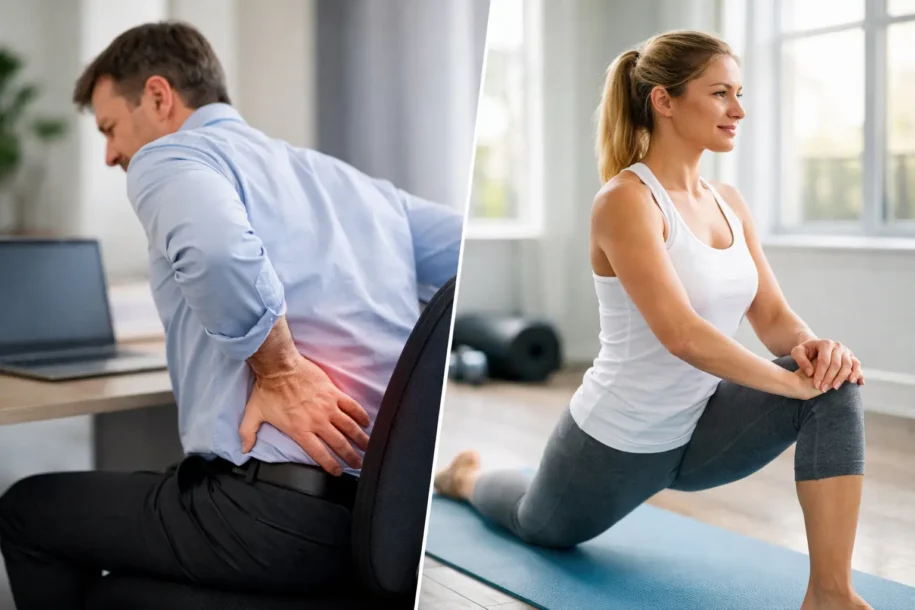
A dull ache on the outside of the hip after a day at your desk can seem minor at first. But when it starts affecting your walk, sleep, exercise or ability to get comfortable on the sofa, it deserves more than a quick stretch. Hip pain caused by poor posture is often not just a problem in the hip itself. It can reflect how the pelvis, lower back, legs and surrounding muscles are working together.
Poor posture is rarely one fixed position that suddenly causes damage. More often, it is the repeated loading of the body in a position that it is not coping with well. Long periods of sitting, always leaning onto one leg, reduced movement after an injury, or an altered walking pattern can gradually place more strain on one side of the body.
How poor posture can lead to hip pain
Your hips sit at the meeting point between the pelvis and the legs. They need to be mobile enough for walking, climbing stairs and bending, while also providing a stable base for the spine. When the pelvis or lower back is not moving and loading well, the hips often have to compensate.
For example, prolonged sitting can leave the hip flexor muscles at the front of the hip working in a shortened position for hours at a time. This does not mean sitting automatically causes injury, but it can contribute to stiffness and reduced movement tolerance, especially when combined with little variation during the day. Standing with most of your weight through one leg may also place repeated strain through the outer hip muscles and the side of the pelvis.
A forward-leaning posture, an exaggerated arch in the lower back, or a pelvis that repeatedly shifts to one side can change how force travels through the hips. Over time, this may irritate muscles, tendons or joints around the hip. It can also make an existing issue more noticeable.
The relationship works both ways. A painful or stiff hip can cause someone to alter their posture and walking pattern. This is why a thorough assessment matters. Treating posture as the only cause can miss an underlying issue in the hip, pelvis or lumbar spine.
Signs your hip pain may be posture-related
Posture-related hip pain often builds gradually rather than beginning with one clear incident. You may notice discomfort after sitting at work, driving, standing in a queue or lying in one position at night. Some people feel a tight or pinching sensation at the front of the hip, while others experience aching over the outside of the hip, buttock or lower back.
The pattern of symptoms can offer useful clues. Pain that eases after changing position or walking for a few minutes may suggest that prolonged loading is a factor. Discomfort that returns every time you sit, cross your legs, stand unevenly or complete a particular movement deserves closer attention.
You may also notice reduced hip rotation, difficulty getting out of a low chair, discomfort when walking uphill, or a feeling that one side is doing more work than the other. These signs do not provide a diagnosis on their own, but they can indicate that your movement pattern needs to be assessed.
The lower back is often part of the picture
Pain felt around the hip does not always come from the hip joint. The lumbar spine, sacroiliac joints, gluteal muscles and nerves can all refer discomfort into the buttock, side of the hip or upper thigh. This is particularly relevant if hip pain is accompanied by lower-back stiffness, pain travelling down the leg, tingling or numbness.
In some cases, disc irritation or sciatica can feel like hip pain. In others, reduced movement in the lower back may lead to compensatory movement at the hip. Looking at the body as a connected system helps distinguish where symptoms are coming from and what is maintaining them.
Why simply “sitting up straight” is not always the answer
Many people respond to postural discomfort by trying to hold themselves rigidly upright. This can create more tension, particularly through the neck, lower back and hip flexors. Good posture is not about maintaining one perfect position all day. It is about having enough control, strength and movement options to change position comfortably and tolerate daily activity.
An ergonomically sensible workstation can help, but it is only one part of the solution. A supportive chair will not fully address a hip that is weak, stiff, irritated or compensating for spinal dysfunction. Equally, exercises may not settle symptoms if a person continues to load one side heavily because of an unrecognised movement restriction.
The right approach depends on the cause, the location of pain and how long it has been present. Someone whose symptoms started after several weeks of home working may need different support from an active runner with hip pain and reduced lower-back movement.
Practical steps that may reduce hip strain
Small, consistent changes are usually more useful than a dramatic attempt to correct posture overnight. Break up sitting regularly by standing, walking around the room or changing tasks. The goal is variation rather than perfection. If you work at a desk, check that your screen, keyboard and chair allow you to sit without constantly twisting, reaching or leaning.
When standing, try not to settle into one hip for long periods. If you notice yourself always carrying a child, bag or shopping on the same side, alternate where practical. During daily activities, move within a comfortable range rather than pushing repeatedly through sharp pain.
Gentle hip and lower-back movement can be useful for some people, particularly when stiffness is a key feature. However, stretching aggressively into a painful hip is not always helpful. Outer-hip pain, tendon irritation and joint-related symptoms can all worsen when exercises are poorly matched to the problem.
Strength and control through the gluteal muscles, trunk and legs also matter. But rehabilitation should be based on what your assessment shows, not on a generic online routine. The best exercise is one that improves your movement and confidence without flaring symptoms afterwards.
Assessment for hip pain caused by poor posture
At Reliable Spine, assessment looks beyond the point of pain. A clinician will consider your hip movement, pelvic position, spinal function, walking pattern and how you perform everyday movements such as sitting, standing, bending and stepping. Your history is equally important: when symptoms occur, what changes them, whether pain travels, and whether previous injury or activity changes may be contributing.
This broader view can identify compensatory patterns that are otherwise easy to overlook. If the lower back is restricted, for instance, the hip may be moving more to make up for it. If pain has caused you to offload one leg, the opposite side may be taking more strain. Addressing these patterns can help reduce repeated irritation and improve function.
Care may include targeted chiropractic treatment to improve spinal and joint movement where appropriate, alongside personalised rehabilitation and advice on daily loading. For people with disc-related symptoms or nerve involvement, management may need to focus more closely on the spine, with spinal decompression considered for suitable cases. The plan should always reflect the findings of your assessment rather than applying the same treatment to every hip problem.
When hip pain needs prompt medical attention
Do not assume all hip pain is postural. Seek urgent medical advice if you have severe pain after a fall or injury, cannot bear weight, develop fever or feel unwell, or notice a hot, swollen or visibly deformed joint. New bowel or bladder changes, numbness around the saddle area, significant leg weakness, or rapidly worsening pain with neurological symptoms also require urgent assessment.
Persistent night pain, unexplained weight loss or pain that is steadily worsening despite reducing activity should be checked by an appropriate healthcare professional. A careful assessment is especially worthwhile when symptoms have lasted several weeks, keep returning or are limiting work, sleep or exercise.
Your hip should not dictate how far you can walk, whether you can train, or how long you can sit through a meeting. If discomfort keeps returning, understanding the movement and spinal factors behind it is a practical first step towards moving more comfortably again.
Leave a Reply