
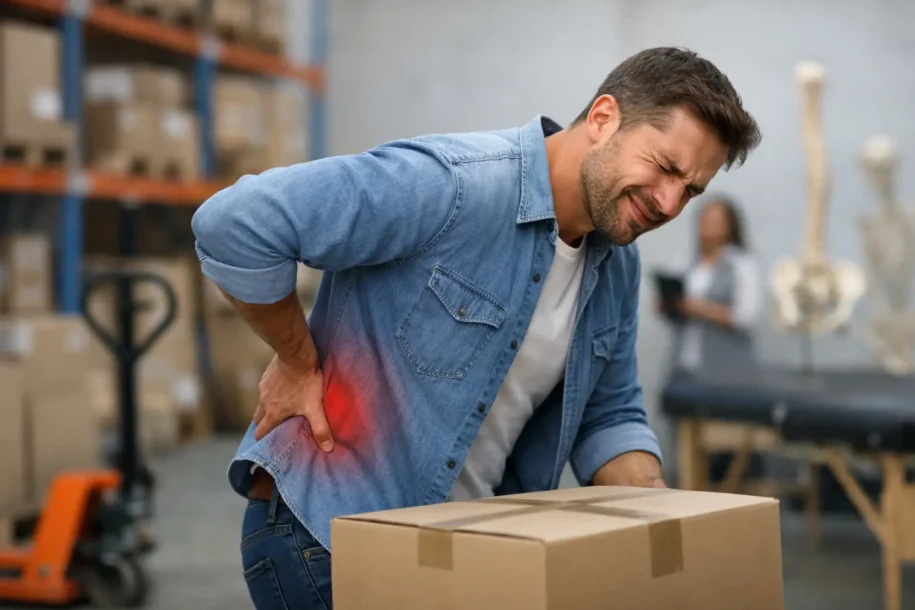
A single awkward lift can change the rest of your week. You may feel a sharp pull as you raise a heavy box, or wake the next morning with stiffness that makes getting out of bed, driving or putting on your shoes difficult. Back pain after lifting heavy objects is common, but it should not automatically be dismissed as something you simply have to push through.
The back is designed to handle load. Problems often arise when the load is heavier than expected, held too far from the body, lifted while twisting, or added to a spine already affected by poor movement, prolonged sitting or previous injury. The right next step depends on your symptoms, how they are changing and whether nerve tissue may be involved.
Why lifting can trigger back pain
Many lifting injuries involve irritation of the muscles, ligaments and small joints around the lower back. A sudden overload can cause protective muscle spasm, local tenderness and stiffness. Pain may be worse when bending, straightening up, coughing or changing position after sitting.
However, not all pain after a lift is a simple muscle strain. The discs between the spinal bones absorb pressure and allow movement. When a disc is irritated or injured, pain may be deeper and more persistent. It can sometimes travel into the buttock, hip or leg if nearby nerve tissue is affected. This is often described as sciatica, although leg pain has several possible causes and needs proper assessment.
Your body also compensates. If your hips are restricted, your core control is poor, or you have been moving around an old shoulder, knee or back problem, the lower back may take more strain than it should. The lift may be the final trigger, rather than the whole cause.
The first 48 hours: protect movement, do not stop completely
It is sensible to avoid the activity that triggered the pain, particularly repeated bending, twisting and heavy lifting. But complete bed rest usually makes the back feel stiffer and can reduce confidence in movement. Aim for relative rest: move little and often within a comfortable range, change position regularly, and use short walks if these do not sharply increase symptoms.
A cold or warm pack may provide temporary comfort. Some people prefer cold in the first day or two, while others find gentle warmth eases muscle guarding. Use a barrier between the pack and skin, and do not rely on either approach as a substitute for addressing the injury.
Over-the-counter pain relief may be suitable for some people, but it is best to check with a pharmacist or GP, especially if you have stomach, kidney, heart or liver conditions, take regular medication, are pregnant, or have had a previous reaction to anti-inflammatory medication.
The aim is not to prove that you can tolerate pain. It is to settle irritation while keeping the body moving safely enough to prevent further loss of function.
When back pain after lifting heavy objects needs urgent help
Most acute back pain improves with sensible management, but a small number of symptoms require urgent medical attention. Seek urgent assessment through NHS 111, your GP, or emergency services where appropriate if back pain is accompanied by any of the following:
- new difficulty controlling your bladder or bowel
- numbness around the genitals, buttocks or inner thighs
- rapidly worsening weakness, foot drop, or major loss of leg control
- severe pain after a significant fall, collision or crush injury
- fever, unexplained weight loss, a history of cancer, or feeling generally unwell alongside severe back pain
New leg pain, tingling or numbness is not always an emergency, but it should not be ignored, particularly if it is worsening or limiting walking, sleep or normal activity. A clinical assessment can help establish whether the source is muscular, joint-related, disc-related or associated with nerve irritation.
Signs that an assessment is worthwhile
You do not have to wait until pain becomes unbearable before seeking help. An assessment is particularly useful when pain has not started to improve after several days, keeps returning with everyday tasks, or has changed how you walk, sit, sleep or work.
It is also worth being assessed if you cannot comfortably bend or straighten, pain spreads below the knee, or you feel that your back is constantly “going out”. Recurrent episodes are a sign to look beyond the immediate flare-up. Treating only the painful area without considering lifting mechanics, hip movement, posture and spinal function can leave the same vulnerability in place.
At Reliable Spine, assessment focuses on the pattern behind the pain, not just the sore spot. This may include a detailed history, movement testing, spinal analysis and neurological checks where indicated. The goal is to understand which movements aggravate symptoms, what structures may be involved and which parts of the body are compensating.
Treatment depends on what has been irritated
A personalised plan should reflect your presentation rather than follow a one-size-fits-all timetable. Early care may focus on reducing pain, restoring more comfortable movement and helping you return to essential daily activity. As symptoms settle, rehabilitation becomes increasingly important.
For muscular or joint-related pain, hands-on chiropractic care may be combined with mobility work, progressive strengthening and advice on modifying tasks temporarily. The purpose is not simply to make the back feel looser for a day. It is to improve movement control and load tolerance so that ordinary activities become less threatening.
Where assessment suggests a disc injury or nerve irritation, care needs to be more specific. Some people benefit from positions and movements that reduce leg symptoms; others need a more cautious approach while acute irritation settles. Advanced spinal decompression may be considered for appropriate cases as part of a wider non-surgical management plan. It is not suitable for every type of back pain, which is why a proper examination comes first.
Imaging is not automatically needed after every lifting injury. Scans can be valuable when symptoms, examination findings or red flags suggest they are necessary, but many changes seen on scans are also present in people without pain. Clinical findings and your response to care matter.
Returning to lifting without repeating the problem
The most useful lifting advice is practical: get close to the object, assess its weight before committing, keep it near your body and avoid twisting while carrying it. Turn with your feet instead. If you need to place an object to one side, step around rather than reaching and rotating through the lower back.
Technique matters, but it is only part of the picture. No lifting position makes an object that is too heavy, bulky or unstable completely safe. Break the load down, use a trolley where possible, ask for help and plan the route before you lift. These choices are especially relevant when moving furniture, gardening, handling stock at work or lifting children repeatedly from low positions.
Rehabilitation should gradually rebuild capacity. Depending on your assessment, this may include hip mobility, trunk endurance, gluteal strength, balance and controlled hinging practice. The right exercises should challenge you without reproducing sharp or spreading pain. A gradual return is usually more productive than avoiding all loading for weeks, then attempting the same heavy task without preparation.
Do not let a short-term injury become a long-term restriction
Pain can make people understandably cautious, yet fear of bending or lifting can become its own limitation. The answer is not to force through severe symptoms. It is to rebuild trust in movement in measured stages, with a clear understanding of what your back can tolerate now and what it needs to tolerate next.
If your back pain is persistent, recurrent, or affecting work and everyday life, a detailed spinal and movement assessment can provide a clearer route forward. Early, appropriate care can help you move with more confidence and return to the activities that matter to you.
Leave a Reply