
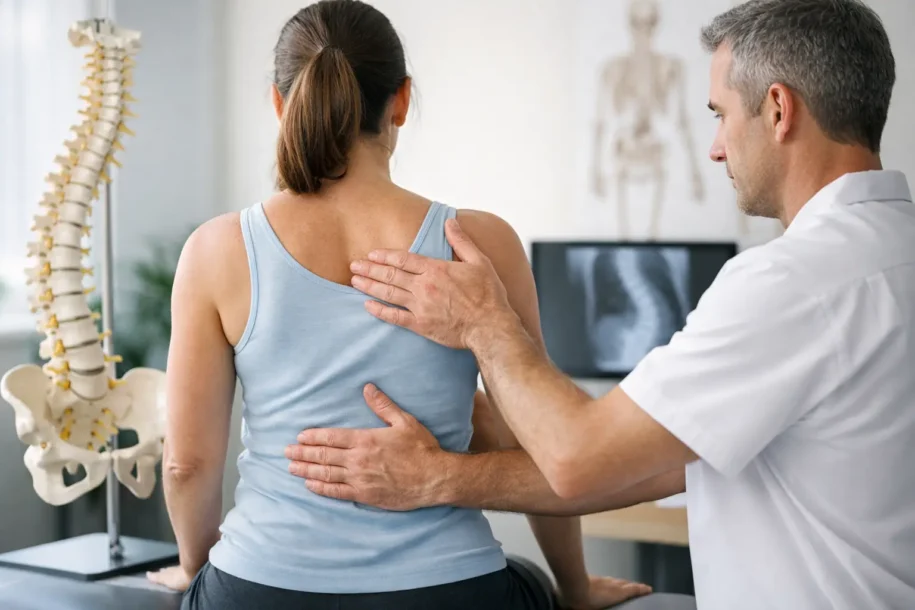
A scoliosis diagnosis can raise immediate questions: is the curve getting worse, is it responsible for the pain, and what can be done without surgery? A good guide to scoliosis management starts with a clear answer: management is individual. The right plan depends on your age, the size and location of the curve, whether it is changing, your symptoms, and how it affects work, exercise and ordinary daily movement.
Scoliosis is a sideways curvature of the spine that also involves rotation of the vertebrae. It can make one shoulder, hip or side of the ribcage look more prominent, but appearance is only part of the picture. Some people have a noticeable curve with little discomfort. Others develop persistent back pain, stiffness, fatigue, altered movement patterns or pain around the neck, shoulders, hips and knees as the body compensates.
The aim is not simply to chase pain on a difficult day. It is to understand how your spine and whole body are functioning, reduce the stresses that are contributing to symptoms, and build confidence in movement.
Understanding when scoliosis needs attention
Scoliosis often develops during adolescence, when growth can make a curve more likely to progress. In adults, it may be a curve that has been present since childhood, or a degenerative curve that develops as discs and joints change over time. Adult scoliosis can be linked with stiffness, one-sided back pain, reduced walking tolerance, sciatica-like symptoms or a feeling that the body is no longer moving evenly.
Pain does not always match the size of a curve. A relatively modest curve may be painful if it is accompanied by disc irritation, joint restriction, muscle guarding or poor load tolerance. Equally, a larger curve may be well managed if the person remains strong, active and well adapted. This is why an X-ray alone cannot tell the full story.
Seek urgent medical advice if back pain is accompanied by new bowel or bladder changes, numbness around the groin or saddle area, rapidly worsening leg weakness, unexplained weight loss, fever, or severe pain following significant trauma. These symptoms require prompt assessment and should not be managed as routine scoliosis pain.
Assessment comes before treatment
Effective scoliosis management begins with a detailed assessment rather than a generic set of exercises. At Reliable Spine, this means discussing when symptoms began, what aggravates or eases them, your activity and work demands, previous injuries, and any history of curve progression or imaging.
A physical examination looks beyond the visible curve. It may assess spinal movement, posture, pelvic position, muscle control, walking pattern, leg and hip function, neurological signs and how you perform movements that matter to you. For an office worker, that may mean sitting and getting up without a flare-up. For an active adult, it may mean returning to the gym, running or lifting with greater control.
Where imaging is available or clinically appropriate, it helps establish the curve pattern and provides a baseline for monitoring. Your clinician may also recommend that you speak with your GP or a spinal specialist, particularly if the curve appears to be progressing, symptoms are severe, or bracing or surgical opinion may be relevant.
The questions a useful plan should answer
A personalised plan should make clear what may be driving your symptoms, which movements or loads are currently poorly tolerated, and what progress is realistic. It should also explain how improvement will be measured. Less pain matters, but so do better movement, longer walking distance, easier sleep, improved strength and a return to the activities you value.
A guide to scoliosis management: the main options
There is no single treatment that suits every curve. For many people, the best approach combines monitoring, hands-on care where appropriate, progressive rehabilitation and practical changes to daily loading.
Monitoring and education
A mild, stable curve with minimal symptoms may need little more than periodic review and sensible advice. Monitoring is particularly important in growing teenagers, because progression risk can change during a growth spurt. In adults, reviews can identify whether pain, function or neurological symptoms are changing, even when the curve itself is long established.
Education should be specific. You do not need to avoid all bending, twisting or exercise because you have scoliosis. However, learning which movements aggravate your current symptoms and how to build tolerance gradually can prevent the cycle of flare-up, rest and deconditioning.
Rehabilitation and movement control
Exercise is a central part of non-surgical scoliosis management, but it should not be reduced to a few stretches copied from social media. A rehabilitation programme may focus on spinal mobility where it is limited, trunk strength and endurance, hip control, breathing mechanics, balance and movement awareness.
The details matter. Someone who sits for long periods may benefit from regular position changes, improved desk set-up and exercises that restore hip and thoracic movement. Someone who trains may need support to adjust lifting volume, improve bracing and rebuild capacity rather than stop activity altogether. Progression should be steady enough to challenge the body without repeatedly provoking symptoms.
Scoliosis-specific exercise approaches may be considered for certain people, especially where curve control, posture and breathing are key concerns. They are not a guaranteed way to straighten a structural curve, but can form part of a wider strategy to improve function and self-management.
Structural spine care and hands-on treatment
Where examination identifies restricted joints, muscle tension or altered movement patterns contributing to pain, chiropractic care may help improve comfort and mobility. Treatment can include carefully selected spinal or joint techniques alongside soft-tissue work and targeted rehabilitation.
Hands-on treatment is most useful when it supports an active plan. It should not create dependence or promise to correct every scoliosis curve. The aim is to reduce barriers to movement, improve how the spine and surrounding joints function, and give you the tools to maintain progress between appointments.
Managing disc and nerve-related symptoms
Some adults with scoliosis also have disc injury, narrowing around spinal nerves or sciatica. In these cases, symptoms may include pain travelling into the buttock or leg, tingling, numbness or reduced strength. Management needs to be more cautious and guided by a neurological assessment.
For appropriate cases, spinal decompression may be considered as part of a non-surgical plan for disc-related symptoms. It is not a treatment for every type of scoliosis, nor is it suitable for everyone. Its place is determined by the underlying problem, your examination findings and your response to care.
Bracing and specialist referral
Bracing is most commonly considered for adolescents who are still growing and have a curve at risk of progression. Its purpose is usually to limit further progression during growth, not to provide a quick cosmetic fix. A specialist team will advise whether a brace is indicated and how it should be monitored.
Surgery is reserved for selected cases, such as curves that are severe, progressing or causing significant functional and neurological problems. Being referred for a surgical opinion does not mean surgery is inevitable. It means you have the information needed to make a well-informed decision.
Everyday habits that support your spine
Daily life can either repeatedly irritate symptoms or help build tolerance. Avoid trying to hold one ‘perfect’ posture all day. Even a good position becomes uncomfortable if you stay in it for hours. Instead, vary your position, stand and walk regularly, and organise your workstation so you are not constantly leaning or twisting towards a screen.
When lifting, keep the load close, use your legs and hips, and avoid rushing when you are tired or already sore. Sleep positions are individual, but a pillow that supports the neck and a mattress that allows comfortable rest are more useful than forcing yourself into a rigid position. If a particular activity consistently causes a flare-up, it may need adapting temporarily, not abandoning forever.
What progress should look like
Progress with scoliosis management is rarely a straight line. A busy week, poor sleep, a long car journey or a sudden increase in training can temporarily increase symptoms. That does not automatically mean your condition is worsening. The key is to recognise patterns, adjust early and return to your plan rather than waiting for pain to become limiting.
For some people, success means fewer episodes of back pain. For others, it means walking further, returning to sport, sitting through a working day more comfortably or feeling less worried about movement. A thorough assessment and personalised rehabilitation plan can help turn those goals into practical next steps. If scoliosis is affecting your comfort or confidence in daily life, booking a consultation is a sensible place to begin.
Leave a Reply