
A disc injury can make ordinary movements feel unpredictable. Sitting through a meeting, getting out of the car or bending to put on socks may trigger a deep ache in the lower back, sometimes with pain travelling into the buttock or leg. The best exercises for discogenic pain are not simply the hardest core exercises or the stretches that feel strongest. They are the movements that help you regain control, reduce irritation and gradually build tolerance for daily life.
Discogenic pain originates from an irritated or injured spinal disc. Because discs respond differently from person to person, the right exercise plan depends on your symptoms, movement pattern, spinal function and stage of recovery. A movement that settles one person’s back may aggravate another’s. This is why a detailed assessment matters, particularly when pain is recurrent, limiting work or exercise, or accompanied by sciatica.
Best Exercises for Discogenic Pain: Start With Control
The goal in the early stages is not to force flexibility. It is to find comfortable movement, improve the way the spine and hips share load, and restore confidence without repeatedly provoking symptoms. Exercise should feel manageable during the session and should not cause a clear increase in pain that lasts into the following day.
1. Supported walking
Walking is often one of the most useful starting points for disc-related back pain. It encourages gentle spinal movement, increases circulation and prevents the stiffness that can develop when people understandably avoid activity altogether.
Begin with a short, flat walk at a pace that allows you to stand tall without bracing or limping. For some people, five minutes is the right starting point; others may manage 15 or 20. The useful dose is the one that does not substantially worsen your symptoms later that day.
If standing or walking immediately increases leg pain, a clinician should assess you before you try to push through it. The answer may be a shorter interval, a different starting position or a need to address the underlying mechanical issue first.
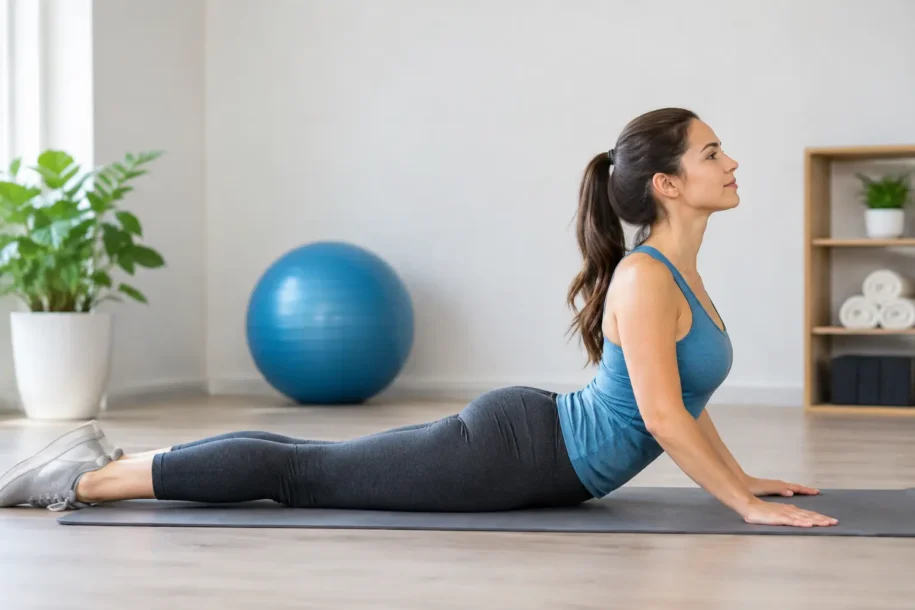
2. Gentle prone lying and press-ups
Some people with discogenic pain feel better when they gradually move into extension, meaning a gentle backward bend. This can be particularly relevant where prolonged sitting and bending forwards bring on symptoms. It is not appropriate for everyone, so use your response as a guide.
Start by lying on your front with a pillow under your hips if needed. Stay there for one or two minutes, breathing normally. If this is comfortable, progress to resting on your elbows. The next stage is a gentle press-up: keep your pelvis on the floor, use your arms to lift your chest a small amount, then return down.
Complete a small number of slow repetitions rather than forcing height. Stop if pain spreads further down the leg, becomes sharper or is clearly worse afterwards. A positive response is often pain becoming less intense or moving from the calf or thigh back towards the buttock or lower back.
3. Pelvic tilts in a comfortable range
Pelvic tilts help you practise controlled lumbar movement without heavy loading. Lie on your back with knees bent and feet on the floor. Gently flatten your lower back towards the floor by tipping the pelvis, then return to a neutral, relaxed position.
Keep the movement small and smooth. You are not trying to press hard through the back or create a dramatic arch. Eight to 10 repetitions can be enough initially. If lying on your back is uncomfortable, this exercise can be modified or replaced following an assessment.
For some patients, particularly those who are sensitive to bending forwards, the backward tilt may not feel right. In that case, do not repeatedly test a painful direction in the hope it will loosen up. The most productive exercise is usually the one that allows calm, controlled movement with fewer symptoms.
4. Abdominal bracing with normal breathing
A painful back often causes the surrounding muscles to either switch off or work far too hard. Gentle abdominal bracing can help improve trunk control without the strain of sit-ups, crunches or long planks.
Lie on your back with knees bent, or stand if that position feels better. Tighten the lower abdominal muscles as though you are preparing for a light cough, while continuing to breathe. Hold for five to 10 seconds, then fully relax. Aim for quality rather than intensity.
This is not about pulling your stomach in as hard as possible. Excessive gripping can make movement rigid and uncomfortable. The aim is a steady, controlled trunk that supports normal activities such as standing up, carrying shopping or walking.
5. Bridge progression
Once basic control is improving, a bridge can build strength through the glutes and hips. These muscles help reduce unnecessary demand on the lower back during lifting, climbing stairs and getting up from a chair.
From the same bent-knee position, gently brace your abdomen and squeeze your buttocks to lift your hips a short distance. Keep your ribs relaxed and avoid thrusting into a large arch at the top. Lower slowly and repeat six to 10 times if it remains comfortable.
A bridge should feel like work in the buttocks and thighs, not a pinch or sharp pressure in the lower back. If it aggravates symptoms, reduce the height, slow the movement or return to simpler control work. Progression should follow your response, not a fixed timetable.
6. Hip hinge practice
Many disc injuries become irritated by repeated bending from the lower back, especially when lifting is combined with twisting or rushing. Learning a hip hinge helps you bend while keeping the spine more controlled.
Stand with your feet hip-width apart and soften your knees. Place your hands on the fronts of your thighs, then send your hips backwards as though you are closing a car door with your hips. Let your torso tip forwards as one unit, maintaining a comfortable neutral spine. Return by pressing through your feet and squeezing the buttocks.
At first, keep the range small and practise near a wall so you have a clear target for your hips. This is a practical rehabilitation exercise because it can transfer directly to picking up laundry, unloading the dishwasher and returning to gym-based strength training safely.
Exercises That May Need Caution
There is no universal banned exercise list for a disc injury, but certain movements commonly need modification while symptoms are active. Repeated toe-touching, aggressive hamstring stretching, loaded spinal flexion and twisting under load can be unhelpful where bending is already sensitive. High-impact running, heavy deadlifts and sit-ups may also be too demanding before spinal control and load tolerance have returned.
That does not mean you must avoid these activities forever. It means they should be reintroduced at the right stage, in the right dose and with better technique. A runner may need a gradual return-to-impact plan; a gym user may need to rebuild their hinge and squat pattern before lifting heavily again.
How Often Should You Exercise?
Gentle movement exercises are often best performed little and often. A short walk or a few comfortable repetitions several times a day can be more useful than one long session that flares symptoms. Strength and control exercises may begin every other day, allowing time to see how your back responds.
Use a simple symptom check. Mild discomfort that settles quickly may be acceptable, especially when recovering from persistent pain. Increasing leg symptoms, numbness, weakness or pain that remains significantly worse the next day suggests the exercise, range or volume needs to change.
When Discogenic Pain Needs Assessment
Exercise is valuable, but it is only one part of managing a disc-related problem. Persistent symptoms may reflect poor spinal loading, reduced joint movement, muscular compensation or a pattern of movement that keeps irritating the disc. A personalised plan can identify whether your back responds better to extension, flexion, unloading, stabilisation or a combination of these approaches.
Seek urgent medical attention for new bladder or bowel changes, numbness around the saddle area, rapidly worsening leg weakness, fever, unexplained weight loss or severe pain following significant trauma. These symptoms need prompt assessment rather than self-management.
For ongoing back pain, sciatica or repeated flare-ups, a thorough spinal assessment can help establish a safer route back to work, exercise and everyday movement. At Reliable Spine, rehabilitation is tailored around how your spine moves, what triggers your symptoms and the practical activities you want to return to. The right exercise is not necessarily the most challenging one. It is the one that helps you move with less fear, more control and steadily improving function.
Leave a Reply