
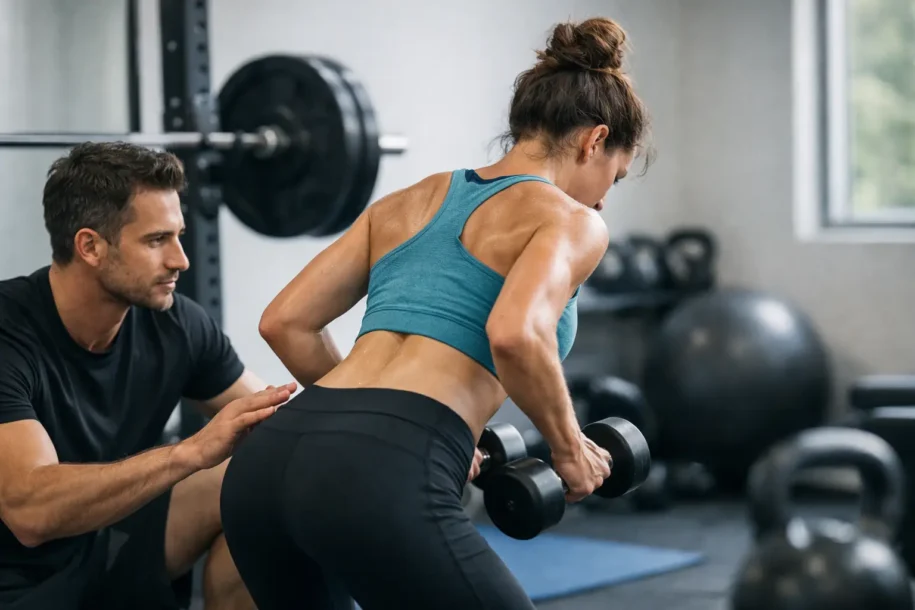
A gym programme can look sensible on paper yet still leave you with a flare-up in one side of your low back, a tight hip or pain travelling into the leg. If you want to exercise safely with scoliosis, the starting point is not finding one perfect exercise. It is understanding how your spine, symptoms, movement habits and current fitness interact, then building capacity at a pace your body can tolerate.
Scoliosis is a sideways curvature of the spine, often accompanied by some rotation. It varies greatly from person to person. Some people have no pain and remain very active, while others notice recurring back ache, muscle fatigue, rib or hip asymmetry, reduced confidence with training, or compensatory discomfort through the neck, shoulders, hips and knees. The curve itself does not automatically tell us what you can or cannot do.
Start with your symptoms, not the diagnosis alone
A scoliosis diagnosis is useful, but it is only part of the picture. The location and severity of a curve, whether it is structural or functional, your age, previous injuries, work demands and training history can all influence the most suitable approach. Someone who sits at a desk in Glasgow for most of the week may need a different starting point from a runner returning after sciatica or a regular gym-goer managing long-standing one-sided back pain.
Before increasing exercise, pay attention to your baseline. Consider what movements bring on symptoms, how long discomfort lasts afterwards, whether one side feels weaker or less controlled, and whether pain affects sleep, walking or everyday tasks. A mild muscular ache after a new workout is not unusual. Sharp pain, worsening nerve symptoms or a significant change in function needs a more careful response.
A detailed spinal and movement assessment can identify patterns that a diagnosis label alone cannot. This may include restricted spinal movement, altered pelvic control, weak or overworked muscles, reduced hip mobility, poor load tolerance or compensations that have developed over time. The aim is not to make your body move identically on both sides. It is to improve control, strength and confidence in the movements that matter to you.
How to exercise safely with scoliosis
The most reliable approach is gradual, individual and consistent. Exercise should challenge you without repeatedly aggravating symptoms. If a movement causes pain that builds during the session, alters how you move, or leaves you substantially worse later that day or the following morning, reduce the range, resistance, repetitions or frequency. If symptoms settle quickly and you feel capable, modest progression is usually more helpful than avoiding movement altogether.
Start by choosing activities you can perform with good control. Walking, cycling, swimming, cross-training and low-impact classes can all be appropriate, depending on your symptoms and technique. Swimming is often described as ideal for every person with scoliosis, but it is not automatically comfortable for everyone. Repeated extension and rotation during some strokes may irritate certain backs, while others find the water supportive and enjoyable. Your response matters more than the reputation of an activity.
Strength training is also commonly valuable. Well-selected resistance exercise can improve the capacity of the muscles around the trunk, hips and shoulders, making daily lifting, carrying, climbing stairs and returning to sport feel more manageable. The objective is not simply to train the “core” in isolation. A useful programme develops the whole system: trunk endurance, hip strength, upper-back control, leg strength, balance and the ability to breathe and move without bracing excessively.
For many people, this begins with controlled bodyweight movements, light resistance or machines that provide stability. Squats to a comfortable depth, step-ups, hip hinges, rowing variations, supported presses, carries and carefully selected trunk-control exercises may all have a place. The right choice depends on your presentation. One person may need to rebuild confidence in bending and lifting; another may need to improve overhead control or tolerate rotation gradually for golf, tennis or work.
Build load gradually rather than avoiding it
Avoiding every bend, twist or weight can make the body more guarded and less prepared for ordinary life. Equally, pushing through persistent pain in the hope that it will strengthen the spine is rarely productive. The middle ground is graded exposure: introduce an achievable amount of movement, allow the body to adapt, then progress one variable at a time.
For example, you might first improve the quality of a movement, then add repetitions, then add a small amount of resistance. Do not increase weight, training frequency and exercise complexity all in the same week. Keep a simple record of what you did and how you felt later that day and the next morning. This can reveal whether a flare-up came from one exercise, a sudden jump in workload, poor sleep, a long day sitting or a combination of factors.
Technique matters, but it should not become a source of fear. You do not need a perfectly rigid spine for every exercise. Instead, aim for a position that feels controlled, allows comfortable breathing and can be maintained under the load you have chosen. Use mirrors, video feedback or guidance from a qualified clinician or exercise professional where needed. A slower tempo and smaller range can be useful while you learn, but neither needs to remain limited forever if your tolerance improves.
Exercises that may need individual modification
There is no universal ban on running, weights, yoga, Pilates, rotation or sport for people with scoliosis. However, some movements deserve individual assessment when they repeatedly trigger symptoms or when there is a history of disc injury, sciatica, significant pain or loss of control.
Heavy lifting from the floor, deep loaded flexion, repeated end-range twisting, high-impact jumping and fast overhead movements can be demanding because they combine force with balance and timing. They may be entirely manageable for an experienced, symptom-free person who has progressed to them. For someone returning after a flare-up, they may need to be scaled, supported or temporarily replaced while strength and movement confidence improve.
Be cautious with exercises that encourage you to force an asymmetrical position because you think it will “straighten” the curve. Scoliosis-specific rehabilitation can be helpful for some people, especially when prescribed after a thorough assessment, but random corrective drills from social media may not match your curve or symptoms. More stretching is not always the answer either. A tight area may be working hard to provide stability, and aggressive stretching can sometimes leave it more irritated.
Know when to stop and seek assessment
Exercise discomfort and warning signs are not the same. Stop the activity and arrange professional advice if you develop symptoms such as:
- pain shooting into the buttock, leg or arm, particularly if it is increasing
- numbness, tingling or new weakness
- loss of coordination, balance or grip strength
- pain that is severe, constant, worsening at night or unrelated to movement
- changes in bladder or bowel control, or numbness around the saddle area, which require urgent medical attention
Persistent pain does not always mean serious damage, but it does deserve proper assessment when it is limiting work, sleep, training or day-to-day activities. This is particularly relevant if you have been modifying your routine for weeks without meaningful improvement.
Make exercise part of a wider rehabilitation plan
The best training plan fits your life. A person with a physically demanding job may benefit from rehabilitation that prepares them for lifting, carrying and prolonged standing. An office-based professional may need strategies to break up sitting, improve tolerance for commuting and strengthen the areas that fatigue during the day. An active adult may need a staged route back to running, the gym or team sport rather than a vague instruction to “take it easy”.
At Reliable Spine, scoliosis management begins with assessing spinal function, movement patterns and the factors contributing to your symptoms. Where appropriate, care may include tailored rehabilitation alongside structural spine care and non-surgical treatment options. The purpose is to reduce pain, restore function and give you a practical route back to the activities you value.
Your programme should evolve as your capacity changes. The most useful exercise is rarely the hardest one or the trendiest one. It is the movement you can practise consistently, progress with confidence and use to make everyday life feel less restricted.
Leave a Reply