
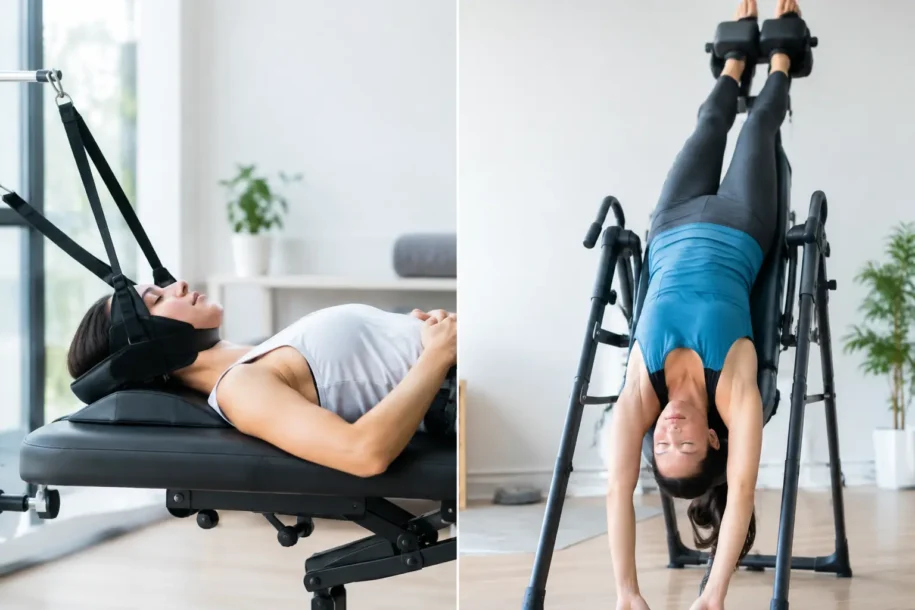
A back that feels fine standing but sends pain into the buttock or leg when you sit, bend or get out of the car may need more than a general stretch. When considering decompression versus inversion therapy, the key question is not which option sounds more powerful. It is which approach matches the cause of your symptoms, your medical history and what your spine can tolerate safely.
Both methods aim to reduce pressure around the spine, but they do so in very different ways. One is a structured clinical treatment that can be adjusted to the individual. The other uses gravity and body position, often at home. For people in Thornliebank and Greater Glasgow dealing with persistent back pain, sciatica or suspected disc irritation, understanding that difference can prevent a great deal of trial and error.
What is spinal decompression?
Spinal decompression is a non-surgical treatment designed to apply controlled traction to the spine. You lie comfortably on a specialised table while a computer-guided system gently changes the pulling force and angle. The aim is to create periods of reduced pressure within targeted spinal segments.
This may be appropriate where symptoms are linked to disc injury, disc bulge, nerve irritation or certain types of persistent mechanical lower back pain. By carefully varying the traction, decompression may help improve comfort, reduce pressure on sensitive structures and support movement while a wider rehabilitation plan addresses the factors that contributed to the problem.
It is not a quick fix for every painful back. Disc symptoms can be influenced by loading at work, prolonged sitting, reduced hip movement, poor lifting mechanics, deconditioning and altered spinal control. A useful decompression programme therefore sits alongside a clear assessment, hands-on care where appropriate, movement rehabilitation and practical advice on managing daily activities.
Why the controlled element matters
The amount of force, the angle of pull and the duration of a session can all be adjusted in spinal decompression. This matters because a person with acute leg pain and limited tolerance for bending needs a different approach from someone whose main problem is recurrent lower back stiffness after long desk-based days.
Treatment can also be monitored as symptoms change. If a position aggravates leg pain, increases numbness or leaves you more restricted afterwards, the plan should be reassessed rather than pushed through. Good care responds to how your body presents, not simply to a standard protocol.
What is inversion therapy?
Inversion therapy usually involves an inversion table that tilts the body backwards so the head moves below the feet. Gravity then creates traction through the spine. Some people use a partial incline, while others invert more fully.
The appeal is understandable. An inversion table can feel relieving for a short period, particularly if your back is stiff after sitting or compression-heavy activity. It is also more accessible than clinic-based treatment for people who want a home option.
However, inversion does not allow the same degree of segment-specific control as decompression. The force is determined largely by body weight and the inversion angle. It cannot selectively target one region of the lower back, nor does it account automatically for pain behaviour, spinal shape, muscle guarding or an underlying condition.
Relief after inversion is not necessarily a sign that it is treating the source of the problem. A temporary reduction in stiffness can still be useful, but it is different from a structured plan to improve spinal function and build confidence in movement.
Decompression versus inversion therapy: the practical differences
The biggest distinction in decompression versus inversion therapy is precision. Spinal decompression is delivered under clinical supervision using controlled traction settings. Inversion relies on whole-body gravitational traction and is generally self-managed.
Decompression is usually part of a care plan after an assessment has identified whether disc involvement, nerve irritation or restricted spinal movement is likely to be contributing to pain. It may be used over a course of appointments, with progress measured through changes in pain, leg symptoms, walking tolerance, sitting comfort and everyday function.
Inversion therapy is often used independently and tends to provide a more general traction sensation. For someone with mild, occasional stiffness and no concerning health factors, a gentle, well-tolerated partial inversion may be a personal comfort tool. It is less suitable as a self-directed response to severe, worsening or unexplained symptoms.
Neither option replaces active rehabilitation. If the muscles and movement patterns that support your back are not addressed, symptoms may return when you resume work, exercise, lifting or the usual demands of family life. The goal is not simply to feel less pressure while on a table. It is to move with less pain and greater control when you are off it.
When decompression may be worth considering
A detailed assessment is especially worthwhile if pain travels into the leg, sitting reliably aggravates your symptoms, coughing or sneezing increases pain, or you have recurrent episodes that keep limiting work or exercise. These patterns can occur with disc-related and nerve-related conditions, although symptoms alone cannot confirm a diagnosis.
Spinal decompression may be considered for suitable patients with disc injuries, sciatica-type symptoms and chronic lower back pain that has not settled with simple self-management. Suitability depends on the examination findings, the severity and behaviour of symptoms, and your wider health history.
At Reliable Spine, this process begins with understanding how your symptoms started, what aggravates or eases them and how they affect normal life. A spinal and movement assessment helps identify whether decompression is a sensible option or whether another form of care, rehabilitation or medical referral is more appropriate.
When inversion therapy may not be suitable
Because inversion changes blood pressure and places you head-down, it is not appropriate for everyone. People with high blood pressure, heart disease, glaucoma or other eye conditions, dizziness, balance problems, recent stroke, pregnancy, or certain joint and bone conditions should seek medical advice before using an inversion table. The same caution applies if you have had recent surgery or have an implanted medical device.
Even without these factors, stop if inversion causes headache, dizziness, increased pain, tingling or a stronger spread of symptoms into the leg. Do not use it to work through severe pain.
Urgent medical assessment is needed for new bladder or bowel changes, numbness around the groin or saddle area, progressive leg weakness, significant trauma, fever with back pain, or unexplained weight loss. These symptoms need prompt investigation rather than traction of any kind.
What a sensible treatment plan looks like
The right plan starts with the problem in front of you, not a preselected treatment. Someone with a recent disc flare may initially need symptom-modifying care, comfortable movement and advice on pacing. As irritation settles, the focus can shift towards restoring spinal mobility, hip function, strength and tolerance for the movements that matter most.
For an office worker, that may mean improving tolerance for meetings, commuting and sitting without repeated flare-ups. For an active adult, it may mean returning gradually to the gym, running or lifting without guarding every movement. For someone with recurrent pain, it may mean identifying the habits and movement patterns that keep loading the same vulnerable area.
Spinal decompression can be a valuable part of this pathway when the assessment supports it. Inversion may have a limited role for selected people who enjoy short-term relief and can use it safely, but it should not substitute for understanding why symptoms keep returning.
The most helpful next step is a proper assessment that gives you a clear explanation, a safe plan and a route back to the activities your back pain has been taking away.
Leave a Reply