
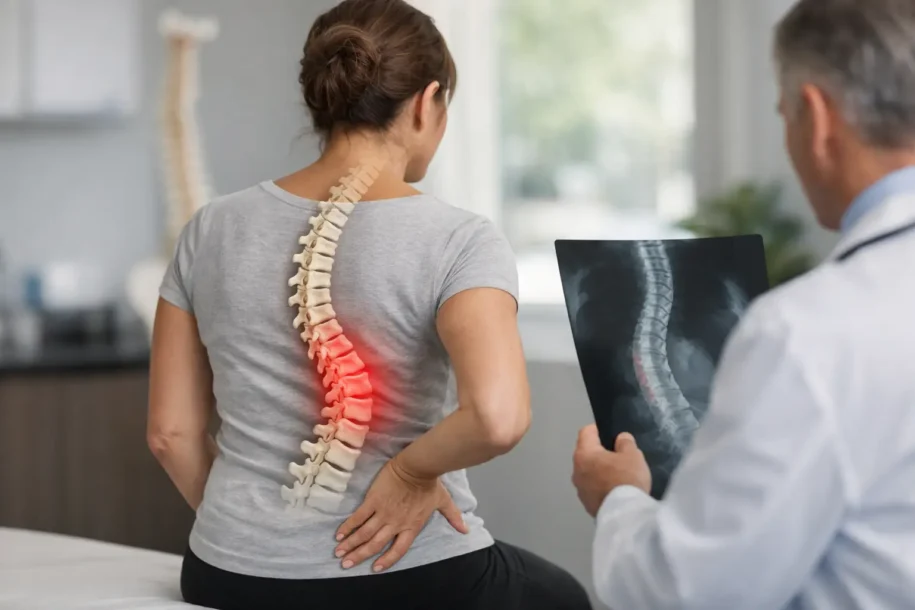
A scoliosis diagnosis can feel like something that belonged to adolescence, until a familiar ache starts limiting your walks, gym sessions, workday or sleep. So, does scoliosis worsen in adults? It can, but progression is not inevitable. The likelihood depends on the type, size and location of the curve, alongside age-related changes to discs, joints, muscles and overall spinal balance.
For many adults, the bigger concern is not simply the number attached to a spinal curve. It is whether the spine is working well enough for everyday life. Back pain, stiffness, fatigue, reduced confidence with movement and compensatory problems through the hips, shoulders or knees can all deserve attention, whether or not a curve is progressing.
Does scoliosis worsen in adults after skeletal maturity?
The common belief that scoliosis stops changing once someone has finished growing is only partly true. The rapid growth-related progression seen in some teenagers usually settles after skeletal maturity. However, an established curve can still change gradually in adulthood, particularly where it is larger, poorly balanced or accompanied by degeneration in the spine.
Research and clinical experience suggest that larger curves are more likely to progress over time. As a broad guide, thoracic curves above around 50 degrees and lumbar curves above around 30 degrees at skeletal maturity may be more likely to increase during adult life. These figures are not a prediction for any one person. Two people with similar X-ray measurements can have very different symptoms, movement patterns and rates of change.
There is also adult-onset, or degenerative, scoliosis. This develops later in life as discs lose height, spinal joints become arthritic and the lower back gradually shifts out of alignment. It can be associated with narrowing around nerves, one-sided leg pain, altered walking tolerance and a feeling that the body is no longer centred over the pelvis.
Why an adult curve may become more noticeable
Scoliosis is a three-dimensional spinal condition. The sideways curve is only one part of the picture. Rotation, changes in the normal spinal curves and the way the head, ribcage and pelvis sit over each other can all affect load and movement.
Ageing does not automatically cause pain, and scoliosis does not automatically explain every episode of back pain. Still, normal age-related changes can expose areas of the spine that have been coping under uneven load for years. A disc may become less tolerant of repeated bending or sitting. Facet joints may become irritated. Muscles on one side of the trunk may work harder to hold posture, while other areas become underused or stiff.
A period of reduced activity can add to the problem. When pain leads someone to avoid walking, strength training or movements they once trusted, trunk and hip strength can decline. The spine may then feel less supported during ordinary tasks such as lifting shopping, standing at work or getting up from a chair. On the other hand, pushing through sharp or increasing pain without understanding the cause can be equally unhelpful.
Hormonal and bone-density changes also matter, particularly after menopause. Osteoporosis increases the risk of vertebral compression fractures, which can alter posture and make an existing curve more pronounced. This is one reason a full assessment should consider more than the visible shape of the back.
Progression and pain are not the same thing
One of the most reassuring and useful facts for adults with scoliosis is that pain severity does not neatly match curve size. A person with a relatively modest curve may have substantial discomfort because of a disc injury, nerve irritation, poor load tolerance or muscular guarding. Another person with a more visible curve may remain active and largely pain-free.
That distinction changes the approach to care. Repeating an X-ray just to chase a number is not always necessary. Where clinically appropriate, imaging can help compare curves, assess degenerative change or investigate new symptoms. But a good examination also looks at posture, spinal movement, walking, strength, neurological signs, breathing mechanics where relevant, and how symptoms behave during daily activities.
The aim is to identify what is driving your current limitation. Is pain coming from a sensitised joint? Is there disc-related pain or sciatica? Are reduced hip movement and trunk control forcing the lower back to do too much? Is a curve affecting balance and load distribution? Clear answers help create a plan that is more useful than simply being told to improve your posture.
Signs it is worth arranging an assessment
Changes do not need to be dramatic before they are worth checking. Arrange an assessment if you have noticed a steady increase in one-sided back pain, stiffness that is affecting work or hobbies, reduced tolerance for standing or walking, or a visible change in shoulder, rib or waist symmetry.
Leg pain, tingling, numbness or weakness may point to nerve involvement, especially in degenerative scoliosis affecting the lower back. New difficulty maintaining an upright posture, a sense of leaning to one side, or pain that repeatedly returns after activity are also good reasons to seek a detailed spinal assessment.
Some symptoms require urgent medical attention rather than routine musculoskeletal care. Seek urgent help for new loss of bladder or bowel control, numbness around the saddle area, rapidly worsening leg weakness, severe pain following significant trauma, fever with back pain, or unexplained weight loss. These are not typical scoliosis symptoms and need prompt investigation.
What non-surgical scoliosis management can involve
Most adults with scoliosis are managed without surgery. The appropriate plan depends on the examination findings, medical history, curve characteristics and personal goals. For someone who wants to return to running, the priorities may differ from those of a person who needs to stand comfortably through a retail shift or sleep without repeated waking.
A personalised programme commonly combines hands-on care, targeted rehabilitation and advice on gradually restoring confidence in movement. Spinal mobility work and chiropractic care may help address restricted segments and painful mechanical dysfunction where appropriate. Rehabilitation should build trunk endurance, hip strength, balance and control rather than relying on passive treatment alone.
For people with disc-related symptoms, sciatica or particular degenerative changes, spinal decompression may be considered as part of a wider plan after a proper assessment. It is not suitable for every condition, and it is not a substitute for clinical screening, active rehabilitation or medical referral when needed.
The honest goal of conservative care is not to promise that every adult curve can be straightened or that progression can always be stopped. It is to improve spinal function, reduce avoidable strain, manage pain and help you do more of what matters to you. In some cases, better movement and conditioning can make a considerable difference even when the X-ray appearance changes very little.
Everyday habits that support a more resilient spine
There is no single perfect posture and no need to hold yourself rigidly all day. What tends to help most is variety. If you sit for work, change position regularly, take short walking breaks and avoid treating one posture as the only “correct” one. A well-set-up workstation can reduce unnecessary strain, but it cannot replace movement.
Regular activity is usually beneficial when it is progressed sensibly. Walking, swimming, cycling, strength work and Pilates-style exercise may all have a place, depending on symptoms and tolerance. The best exercise is not the one with the strongest promise online. It is one you can perform with good control, recover from well and build into consistently.
Pay attention to patterns rather than isolated bad days. If pain reliably increases after a particular movement, work task or training session, that information is valuable. It can guide modifications while the underlying movement issue is addressed. Complete rest is rarely the long-term answer, but neither is ignoring a clear escalation of symptoms.
When monitoring makes sense
Adults with a known curve may benefit from periodic review if they have a larger curve, a history of progression, new pain or functional decline. The interval varies. Someone with a stable, comfortable curve may simply need advice and to return if symptoms change. Someone with degenerative scoliosis, worsening asymmetry or neurological symptoms may need closer monitoring and co-ordinated care with their GP or specialist.
At Reliable Spine, the starting point is a detailed assessment of the whole movement system, not assumptions based on a diagnosis alone. Understanding the relationship between your scoliosis, spinal mechanics, discs, nerves and compensatory patterns provides a more practical route towards reducing pain and restoring function.
If your back is becoming less reliable, do not wait for symptoms to become severe before seeking clarity. A thorough assessment can help establish whether your scoliosis appears stable, what may be aggravating it, and which next steps are most likely to help you move with greater comfort and confidence.
Leave a Reply