
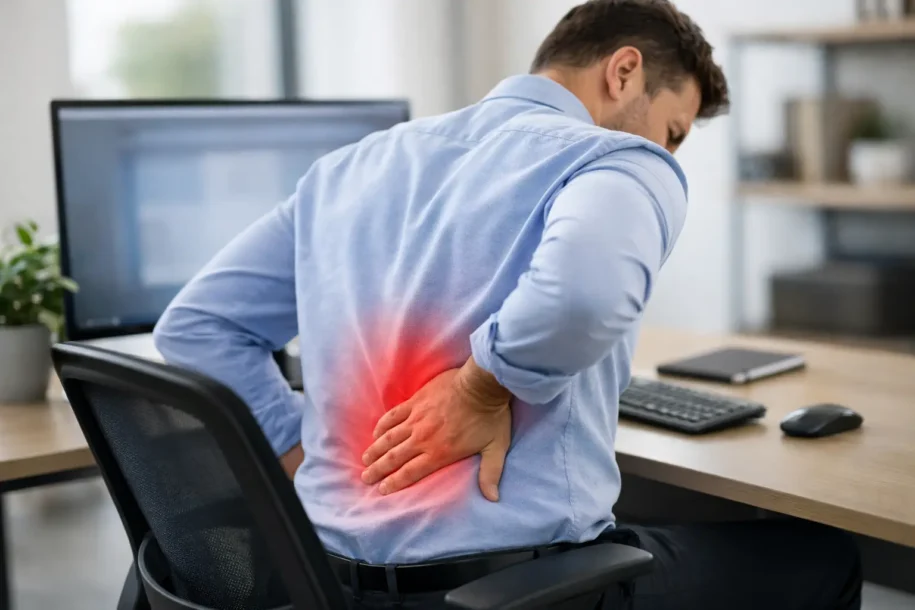
A familiar pattern for many office workers is feeling reasonably comfortable in the morning, then developing an ache, stiffness or sharp catch across the lower back as the working day progresses. Lower back pain when sitting at a desk is not always caused by the chair itself. It can reflect how your spine is coping with prolonged loading, reduced movement, previous injury and the way you sit, reach and work throughout the day.
A new episode may settle with sensible changes and regular movement. However, pain that keeps returning, travels into the buttock or leg, or makes work and everyday activities difficult deserves a proper assessment. The aim is not simply to find a more comfortable position for an hour or two, but to understand why your lower back is becoming sensitive and how to restore more reliable function.
Why sitting can trigger lower back pain
Sitting is not inherently harmful. The issue is usually remaining in one position for too long, particularly when that position places the lower spine, pelvis and surrounding muscles under sustained strain. Even a well-designed chair cannot fully compensate for six or eight hours with very little movement.
When you sit, the pelvis may gradually roll backwards and the natural inward curve of the lower back can flatten. This can increase pressure through spinal joints and discs, especially if you are leaning forward towards a laptop or reaching repeatedly for a keyboard and mouse. Muscles around the hips, abdomen and lower back may then work harder to hold you in position, often leading to fatigue and a persistent dull ache.
For some people, the problem is less about posture and more about tolerance. A previous disc injury, sciatica, joint irritation or long-standing movement restriction can make a particular seated position uncomfortable far sooner than it would be otherwise. Pain is therefore useful information, not a sign that you have failed to sit perfectly.
The role of hips, upper back and work habits
The lower back rarely works in isolation. Tight or poorly controlled hips can alter pelvic position when you sit and stand. Stiffness through the mid-back may encourage you to round your shoulders and lean forwards. A screen positioned too low can keep the head and upper body in a forward posture, increasing strain through the whole spine.
Your working habits matter too. Long video calls, concentrated deadlines and working from a sofa or kitchen chair can reduce the natural opportunities to change position. Some people also notice pain after sitting but not during it, because the transition from sitting to standing exposes stiffness around the spinal joints and hips.
Common patterns of lower back pain when sitting at a desk
A central ache across the belt line that builds through the day may be related to sustained postural loading, muscle fatigue or restricted spinal movement. Pain that is worse when bending forwards, coughing or rising from a chair can sometimes occur with disc-related irritation, particularly if it is accompanied by buttock or leg symptoms.
Pain on one side of the lower back may be linked to asymmetrical sitting, such as crossing the same leg, leaning onto one armrest or keeping a wallet in a back pocket. It may also reflect restrictions through the pelvis, hip or lumbar joints. No single pattern confirms a diagnosis, which is why an individual spinal assessment is more useful than assuming every desk-related problem is simply “bad posture”.
If pain extends below the knee, causes tingling or numbness, or is associated with weakness in the leg or foot, seek clinical advice promptly. These symptoms can indicate nerve irritation and should not be managed by simply stretching harder or buying another chair.
Practical changes that can reduce desk-related strain
The best desk setup is one you can adjust and use alongside regular movement. Aim for a supported but relaxed position rather than trying to hold yourself rigidly upright all day. Your feet should be supported, your knees and hips comfortably bent, and your screen high enough that you are not continually looking down.
Four straightforward changes often make a meaningful difference:
- Sit fully back in the chair, using the backrest for support. A small lumbar support may help if it feels comfortable, but it should not force your spine into an exaggerated arch.
- Keep your keyboard and mouse close enough that your elbows stay near your sides. Reaching forwards all day places unnecessary load through the shoulders and lower back.
- Change position regularly. Stand for a call, walk to refill your water, or take two minutes to move every 30 to 45 minutes.
- Use a laptop stand and separate keyboard where possible. Looking down at a laptop for long periods commonly encourages a rounded upper back and forward head position.
These changes are not a cure for every cause of back pain, but they can lower the amount of irritation your spine has to manage. If a standing desk is available, alternate between sitting and standing rather than replacing one static position with another. Standing continuously can also aggravate the lower back, legs or feet for some people.
Gentle movement beats one perfect posture
A useful rule is that your next position matters more than your current one. Small movements throughout the day help reduce stiffness and allow spinal tissues to experience changing loads. A short walk, a few controlled sit-to-stands, gentle hip movement or a brief change of workspace can all be beneficial.
Exercise outside work is equally important, although the right approach depends on your symptoms. Walking is often a sensible starting point. Gradual strengthening for the hips, trunk and legs can improve capacity for sitting, lifting and daily activity. If you have sharp pain, leg symptoms or a history of disc injury, generic online exercises may not be appropriate. An exercise that helps one person can aggravate another if it does not match the underlying problem.
When your desk pain needs a spinal assessment
It is sensible to seek professional assessment if your lower back pain has lasted more than a few weeks, repeatedly returns, limits work, sleep, sport or walking, or has not improved despite changing your desk routine. Assessment is particularly valuable where pain is accompanied by sciatica, numbness, pins and needles, reduced strength or significant restriction when bending, twisting or getting up from a chair.
A thorough assessment should look beyond the painful area. It may include spinal movement, posture, pelvic and hip function, neurological signs and the way you perform everyday movements. This helps identify whether the main driver appears to be disc irritation, joint dysfunction, muscular compensation, reduced movement control or a combination of factors.
At Reliable Spine, care begins with detailed spinal analysis and a personalised plan based on your symptoms, function and goals. Depending on the findings, treatment may include structural chiropractic care, rehabilitation and advice on modifying aggravating activities. For suitable disc-related cases, spinal decompression may also be considered as part of a non-surgical management plan.
The goal is not to make you dependent on a particular chair, brace or treatment. It is to improve how well your spine and surrounding joints tolerate the demands of work and life, so sitting no longer dictates what you can do after you leave the desk.
Symptoms that should not be ignored
Most desk-related lower back pain is not an emergency, but some symptoms need urgent medical attention. Seek urgent help if you develop loss of bladder or bowel control, numbness around the groin or inner thighs, rapidly worsening leg weakness, severe pain following a significant accident, or back pain alongside unexplained fever, weight loss or feeling seriously unwell.
For less urgent but persistent symptoms, early assessment can prevent a manageable problem from becoming a cycle of flare-ups, reduced activity and growing fear of movement. You do not need to wait until pain is severe to ask for help.
A supportive desk setup and frequent movement breaks are worthwhile, but they are only part of the picture. When pain continues, understanding how your spine moves, what provokes symptoms and what capacity needs rebuilding gives you a clearer route back to comfortable workdays and the activities you value.
Leave a Reply