
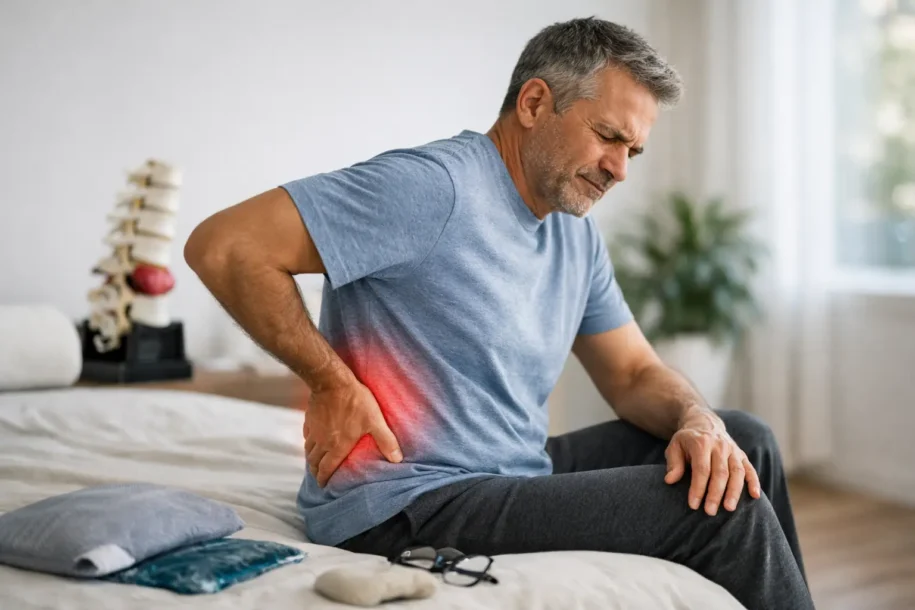
A disc flare can make an ordinary movement – getting out of a chair, putting on socks or reaching into the boot – feel unexpectedly risky. If you are trying to recover from a disc flare, the goal is not to force your back to behave as normal within a few days. It is to settle irritation, protect your confidence in movement and progressively rebuild the strength and control that reduce the chance of another setback.
Disc-related pain can feel intense, but intensity does not always tell you how much damage has occurred. A flare often reflects a sensitive combination of disc irritation, protective muscle tension, reduced movement tolerance and, in some cases, irritation around a nerve root. The right approach depends on your symptoms, your examination findings and how your body responds over time.
What a disc flare can feel like
A lumbar disc flare commonly causes pain in the lower back, often with stiffness, spasm or a sharp catch when bending, sitting or rising from a chair. Some people notice pain travelling into the buttock, thigh, calf or foot. Pins and needles, numbness or weakness may indicate that a spinal nerve is involved, which is why a proper assessment matters.
Symptoms can vary considerably. One person may mainly struggle to sit through a workday, while another is comfortable standing but cannot bend to load the dishwasher. Pain may also shift during recovery. Less leg pain and more local back stiffness can be a positive change for some people, but it should always be considered alongside your overall function and clinical findings.
A scan is not automatically needed for every episode of back pain. Disc bulges and age-related changes are common, including in people without pain. A detailed history, neurological checks and movement assessment can often provide more useful direction at the start, while imaging may be appropriate where symptoms, progress or red flags indicate it.
The first few days: calm the flare without stopping completely
Resting in one position all day can make the back feel stiffer and more guarded. Equally, trying to train through sharp pain, repeatedly testing a painful bend or carrying heavy shopping can prolong a flare. The useful middle ground is relative rest: temporarily reduce the movements and loads that clearly aggravate symptoms while keeping up gentle, tolerable activity.
Short, frequent walks are often better tolerated than one long walk. Change position regularly if prolonged sitting increases your symptoms. If you work at a desk, stand up, walk briefly and reset your posture before discomfort builds. Some people are more comfortable with a small support behind the lower back; others prefer a more upright chair. There is no single perfect sitting position, so use the one that lets you change position and remain comfortable.
Pain relief may help you move more normally, but speak with a pharmacist, GP or prescribing clinician about options that are safe for you, particularly if you have other health conditions or take regular medication. Heat can ease protective muscle tension for some people. It does not repair a disc, but feeling less guarded may make gentle movement easier.
Avoid repeatedly pushing into severe or spreading leg symptoms in the hope that you can stretch the problem away. Aggressive hamstring stretching, forceful twisting and high-impact exercise are rarely the right starting point during an acute flare. The aim is not complete stillness, but controlled exposure to movement.
Recovering from a disc flare is a staged process
A flare settles best when activity is progressed according to symptoms and capacity, not simply by the calendar. Early on, your plan may centre on comfortable walking, supported positions and simple movements that restore confidence without provoking leg pain. As irritability reduces, rehabilitation should become more specific.
Restore movement you can tolerate
A clinician may assess whether certain directions of movement improve, worsen or centralise your symptoms. Centralisation means pain that had travelled into the leg becomes less widespread and moves closer to the back. This is not a rule that applies to every case, but it can be a useful response to monitor.
The exercises prescribed should fit your presentation. For some people, gentle extension-based movements are helpful; for others, a different strategy is more suitable. Copying an exercise programme from social media without knowing how your symptoms respond can be unhelpful, especially where sciatica or nerve symptoms are present.
Rebuild spinal control and strength
Once everyday movements are less reactive, rehabilitation needs to address the reason your back was overloaded in the first place. This can include reduced trunk endurance, poor hip control, deconditioning after avoiding activity, or movement habits that repeatedly place stress on a sensitive area.
The work is usually gradual. You may begin with low-load trunk control, hip and gluteal strengthening, and practising a comfortable hip hinge for tasks such as lifting laundry or reaching low cupboards. The objective is not to brace rigidly all day. It is to build enough control and capacity that your spine can move, bend and handle load without unnecessary fear.
Return to the activities that matter
Getting back to the gym, running, gardening or a physical job should be planned rather than treated as a single pass-or-fail test. Start below the level that caused the flare, then increase one variable at a time: load, repetitions, range, speed or frequency. If you increase everything together, it becomes difficult to tell what your back is reacting to.
A mild, local increase in back discomfort that settles promptly may be manageable during rehabilitation. Pain that is severe, increasingly travels down the leg, or leaves you significantly worse the following day suggests the dose was too high. Reduce the aggravating element and seek guidance rather than abandoning movement altogether.
Everyday habits that can prevent a repeat flare
There is rarely one guilty movement. Disc flares often follow an accumulation of factors: long hours sitting, disrupted sleep, a sudden jump in training, repetitive lifting, stress, reduced fitness or simply doing an awkward task when tired. Looking at the pattern is more useful than blaming a single bend.
For desk-based work, break up prolonged sitting and make your workstation practical, rather than chasing a perfectly upright posture. For manual tasks, bring objects close, use your hips and legs where possible, and avoid twisting under load. These changes reduce unnecessary strain, but your long-term protection comes from building overall tolerance, not avoiding all bending.
Sleep can also affect recovery. Find a position that is comfortable enough to allow rest, using pillows for support if helpful. A period of poor sleep can heighten pain sensitivity and make your back feel more vulnerable, so small changes that improve rest can support the wider rehabilitation plan.
When to seek urgent medical help
Most disc flares improve with sensible management, but certain symptoms need urgent assessment. Seek urgent medical care if you develop new difficulty controlling your bladder or bowel, numbness around the genitals or inner thighs, rapidly worsening leg weakness, or severe symptoms affecting both legs. These can be signs of serious nerve compression.
Arrange a prompt assessment if pain is worsening rather than settling, you have persistent or progressive numbness or weakness, or symptoms are preventing normal walking and daily activity. Back pain following significant trauma, or back pain accompanied by fever, unexplained weight loss or feeling generally unwell, also requires medical attention.
Why a detailed assessment changes the plan
Two people can describe a ‘disc flare’ and need very different care. A thorough spinal assessment considers the location and behaviour of pain, nerve function, posture, movement patterns, work and training demands, previous episodes and contributing problems at the hips, pelvis or upper body.
At Reliable Spine, care for suitable disc injury cases focuses on structural spinal assessment, personalised treatment and rehabilitation aimed at improving function rather than simply masking pain. Where clinically appropriate, spinal decompression may be considered as part of a broader non-surgical management plan. It is not a shortcut or a universal solution, and it works best when paired with an individual plan for movement, strength and day-to-day loading.
A flare can make your back feel fragile, particularly if you have experienced sciatica or been unable to work, exercise or sleep properly. With the right assessment and a paced return to activity, many people regain confidence in their movement. Start with the next tolerable step, then let consistent progress – rather than a rush back to normal – guide your recovery.
Leave a Reply